On this page (5 sections)
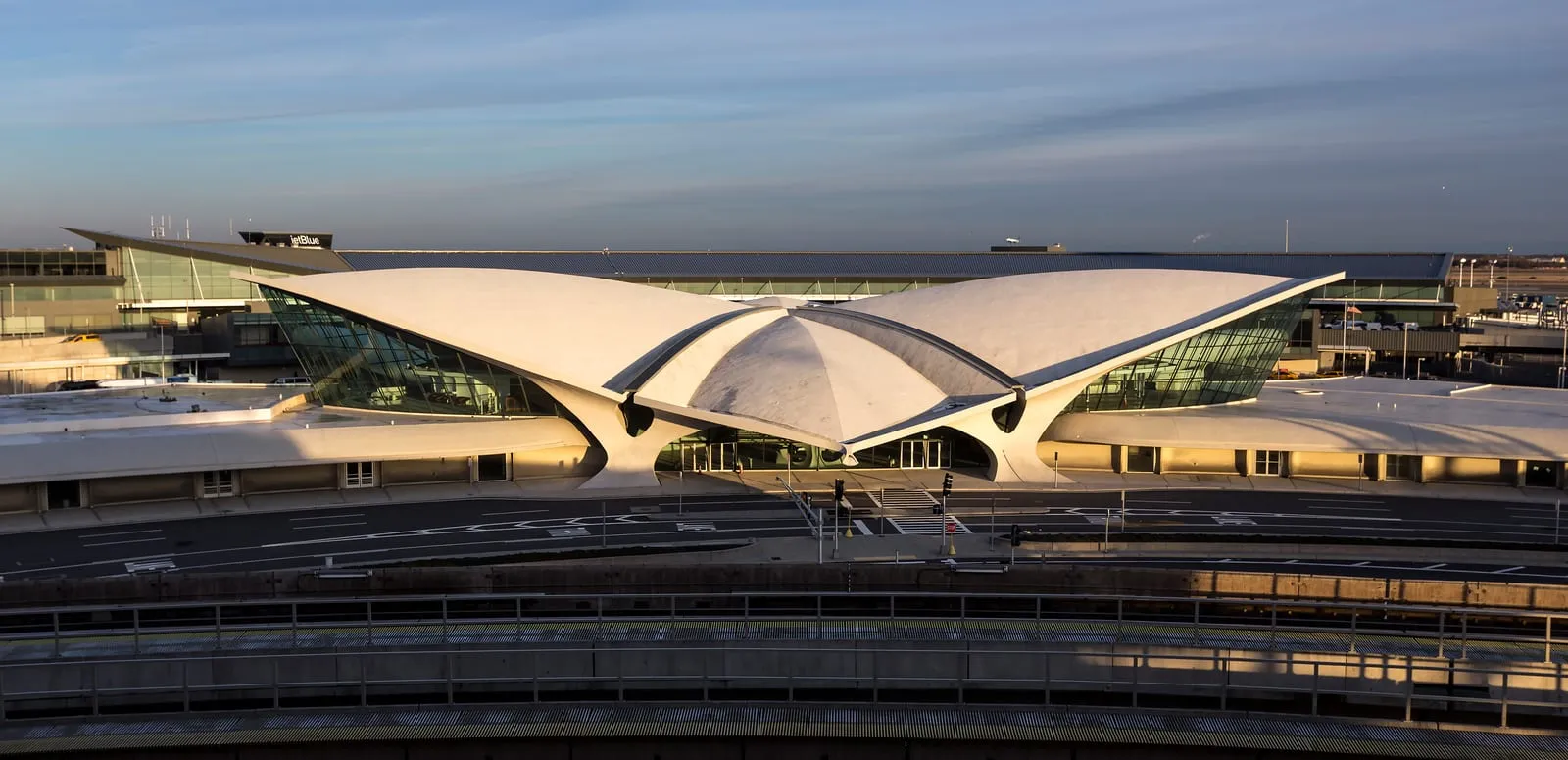
What the building is
The TWA Flight Center is the terminal Eero Saarinen and Associates designed for Trans World Airlines at JFK: a curved concrete roof over a 200,000 square foot headhouse, completed in 1962 and dedicated on May 28 that year. It is the building people mean when they call JFK beautiful, and the reason a landmark designation at this airport covers an interior as well as a facade.
It stopped being a terminal in December 2001, when American Airlines ceased flight operations there. It has taken no passenger flight since, and Terminal 5 was built around and behind it for JetBlue, opening in 2008.
It is protected three separate ways, which is why the restoration had to be a restoration rather than a renovation:
- July 19, 1994: the New York City Landmarks Preservation Commission designated the exterior and the interior as two separate landmarks. The interior designation is the rare one, and it is why the sunken conversation pit at the center of the building is still there rather than gone in a refit.
- June 22, 2005: added to the New York State Register of Historic Places.
- September 7, 2005: added to the National Register of Historic Places.
The headhouse reopened as the TWA Hotel on May 15, 2019, with 512 guest rooms in two new wings built behind it, and the original building working as the lobby, bars and public space rather than as guest rooms.
Visiting without a room
This is the part most guides bury, because most of them are trying to sell you a hotel booking. You do not need a room, a ticket or a reservation to walk into the TWA Flight Center. The headhouse is a public building with bars and restaurants in it, and anyone can go in.
That makes it an unusually good answer to a long layover at JFK, and a genuinely good one to a delay. It is landside, so there is no security to clear to reach it, and it is a short walk from Terminal 5 rather than a shuttle ride. If your day at JFK has three spare hours in it, this beats a gate seat comfortably.
One paid exception, covered below: the rooftop pool and observation deck charge a cover for non-hotel guests. Everything else in the building, including the aircraft, is free to walk through.
The hotel also sells a daytime stay for travelers who want a room for part of a day rather than a night, which is the option worth pricing on a long connection where lying down matters more than sleeping through.
What is actually inside
All of it is landside.
- Connie Cocktail Lounge, a bar inside a restored Lockheed Constellation parked outside the headhouse, at curbside level. You can sit in it for the price of a drink.
- The Sunken Lounge, on Level 2, the conversation pit at the heart of Saarinen's original plan, now a bar.
- Paris Café and Lisbon Lounge by Jean-Georges, on Level 3, the restaurant end of the building.
- A Level 1 food hall holding Crêpes Your Way, Feltman's of Coney Island, Fly-By Bagels, Mister Softee and VINNY'S Panini, plus the TWA Corner Store. Two of those, the Corner Store and VINNY'S Panini, are listed as open 24 hours, which matters if your delay runs through the night.
- Joe Coffee at hotel check-in, and a vintage photo booth and a life-size Twister room in the Saarinen and Hughes wings, which are exactly as odd as they sound.
- The TWA Shop, on Level 2 of the Hughes wing.
- TWA Fitness, whose $25 gym day pass includes showers and the changing area. The airport has no public showers anywhere, so this is the only shower at JFK with a price its operator publishes.
The pool and observation deck
The rooftop infinity pool and observation deck sit on Level 7 and look out over the runways. They are the one part of the building behind a paywall, and the hotel publishes the terms.
- Cover charge: hotel guests from $25 an adult, non-hotel guests from $50. Children 5 to 12 are $10 either way and under-fives are free. For hotel guests the charge is waived entirely from November 1 to May 1.
- Hours: the pool runs 7:00 AM to 11:00 PM for hotel guests and 11:00 AM to 11:00 PM for everyone else. The Pool Bar is 11:00 AM to 11:00 PM daily.
- Each reservation lasts 1 hour 45 minutes, after which the hotel clears the deck to clean it, so it does not accommodate early arrivals either.
- Reservations are required May 1 to November 1. Outside that, walk-ins are welcome 11:00 AM to 11:00 PM but not guaranteed. Hotel guests get a free swim with no reservation from 7:00 AM to 10:45 AM.
- What the charge covers: admission to the pool and deck, towels, and seating to eat at the Pool Bar. It does not cover food and drink, loungers, which cannot be reserved, or showers, which are the separate $25 gym pass.
The rules are stricter than a hotel pool's usually are, and the hotel attributes that to airport security: no outside food or drink, no luggage or bags in the pool area, personal items in a clear bag under 12 by 12 inches which the hotel provides, and no tripods or live streaming without written approval. There are restrooms and changing rooms on the roof but no showers up there.
Worth knowing before you budget for it: the observation deck is the draw rather than the swim, and it is the same $50 for a non-guest either way. On a winter layover, when the hotel heats the pool and the cover charge is at its lowest for guests, the arithmetic is better than in July.
Getting there, and the flight tubes
The building sits in front of Terminal 5, which was built around it, and the AirTrain's Terminal 5 station serves both: the airport's own route map marks the TWA Hotel at that stop. The AirTrain is free between terminals, so from any other terminal at JFK the trip costs nothing.
The connection itself is the best-preserved thing about the restoration. Saarinen's two flight tubes, the carpeted red tunnels that once led passengers from the headhouse out to their aircraft, now lead into the hotel: Flight Tube 1 into the Saarinen wing, Flight Tube 2 into the Hughes wing. You walk between Terminal 5 and a 1962 terminal through a 1962 corridor, which is a stranger experience than any of the photographs suggest.
Two practical notes. Everything here is landside, so a visit from a departure gate means leaving the secure area and screening again on the way back; build that into the time. And this is a Terminal 5 walk, not an airport-wide one, so from Terminal 1, 4, 7 or 8 you are taking the AirTrain first. The terminal overview covers how the buildings relate, including why the numbering skips 2 and 3.
If the reason you are reading this is a night at the airport rather than an interest in the architecture, the guide to sleeping at JFK compares this against staying in a terminal, and against the two places inside the terminals that rent a private room by the hour.