On this page (7 sections)
The six terminals
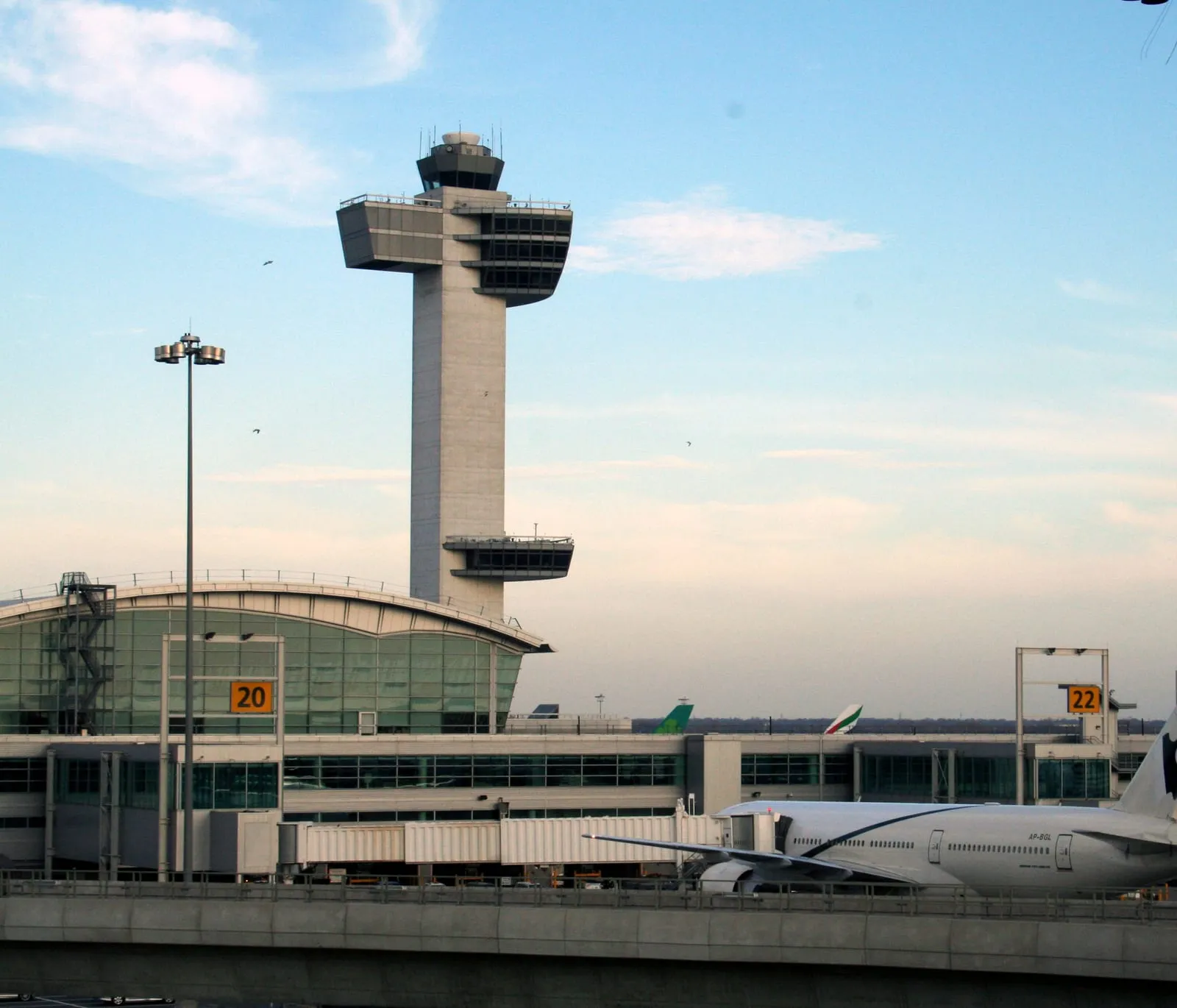
Six terminals operate at JFK. Five have check-in airlines. The sixth, Terminal 6, does not yet.
| Terminal | Airlines checking in | What to know |
|---|---|---|
| Terminal 1 | 26 | Long-haul international, and on borrowed time. Most of its airlines move next door to the New Terminal One; the Lufthansa group is going to Terminal 6 instead. |
| Terminal 4 | 20 | The largest: 36 gates across 1.5 million square feet. Delta Air Lines and its partners, plus Emirates, Etihad Airways and Singapore Airlines. |
| Terminal 5 | 3 | JetBlue Airways and two smaller carriers in one 29-gate building. Some JetBlue departures now use Terminal 6 gates, so check yours. |
| Terminal 6 | 0 | Phase one due in 2026, and no airline checks in here yet. The airport has no page for it. |
| Terminal 7 | 10 | Emptying into Terminal 6 ahead of demolition. Anything you read about it has a shelf life. |
| Terminal 8 | 14 | American Airlines and the oneworld carriers, including British Airways and Qatar Airways. |
That is 73 carriers in total, and these are check-in counts, which is the number that matters when you are deciding where to be dropped off. A terminal can handle a carrier's arrivals without appearing in its check-in row, which is how Terminal 4 takes JetBlue Airways international arrivals overnight while JetBlue checks in at Terminal 5.
The terminals are not equal in size. Terminal 4 spans 1.5 million square feet and 36 gates across two concourses; Terminal 5 is a single 29-gate building. Treat the counts above as a rough guide to how long everything will take once you are inside.
Which terminal you need
Your boarding pass is the answer, and it beats anything published here. If you are booking or planning and do not have one yet, the rule that catches people out is this: go to the terminal of the airline operating the flight, not the airline you booked with. The airport gives its own example, a ticket bought through Finnair on a flight operated by American Airlines, where the terminal you want is American's.
That distinction matters here because the code-share partners are split across buildings, and there is no way to cross between them without leaving security. Delta Air Lines partners are a clean illustration: Aeromexico, KLM Royal Dutch Airlines, LATAM, Virgin Atlantic and WestJet all sit with Delta at Terminal 4, while Air France, China Eastern and Korean Air are at Terminal 1. Same partner list, same booking screen, different buildings.
The full airline list covers every carrier at JFK.
Moving between terminals
Every terminal is connected by the AirTrain, and inside the airport it is free. The fare only starts if you ride out to Jamaica Station or Howard Beach Station, where it is $8.75. There is no walking route between the terminals, which sit around a one-way road loop.
Budget 20min for the AirTrain leg of a terminal change. The airport puts terminal to terminal at under 10 minutes and says you can reach any on-airport destination in under 20, with trains every 5 to 15 minutes, so the wait is the part that varies rather than the ride. Then add the security queue at the far end, which at the bigger terminals can take longer than the whole AirTrain trip.
You will clear security again. Once you reach your departure terminal you must go through TSA screening again, with no exception. That applies to every terminal change here, so plan the transfer as though you were arriving at the airport for the first time, because operationally that is what you are doing. The full terminal transfer guide works the timings through connection by connection, including the international arrival that has to reclaim and recheck bags.
Moving between concourses inside a terminal is different and needs no re-screening. It is worth knowing at Terminal 4, where the two concourses are far enough apart that Delta runs a free shuttle bus between them, and the airport notes the shuttle may not be faster than walking.
Connecting flights
An international arrival connecting to a US domestic flight goes through the full sequence, and it is longer than most connecting passengers expect. The airport sets it out as: immigration and customs, collect your checked bags, recheck them at the recheck area just outside customs, change terminals if you need to, then TSA screening again.
Two things shorten or lengthen that. If you arrived on a preclearance flight, your arrival behaves like a domestic one and you skip the immigration step entirely. The airport counts 15 preclearance locations in six countries, and the list is wider than most people expect: Dublin and Shannon, Abu Dhabi, Nassau, Aruba, Bermuda, and eight Canadian airports including Toronto, Montreal and Vancouver. And if your flights are on separate tickets rather than one booking, you do the whole thing manually: claim your bags, check in again with the second airline, and go through security again. Nobody moves your luggage for you.
Delta's own guidance for a Terminal 1 to Terminal 4 connection is worth quoting as a benchmark: collect and recheck your bags after you clear customs, a step it says can take up to an hour on its own. That is one carrier in one direction rather than an airport-wide rule, but it is the right order of magnitude for the bag step in any international-to-domestic connection here.
If your inbound is late or your onward flight is canceled, the airport's advice is to ask staff at the arrivals gate to point you at your airline's customer service desk rather than joining a queue at a check-in counter.
Why the numbers skip
JFK has no Terminal 2 and no Terminal 3, and it never will again. Terminal 3 was the Pan Am Worldport, opened in 1960 under its famous flying-saucer roof, flown by Pan Am until 1991 and by Delta Air Lines until 2013, and demolished that year. Terminal 2 was demolished in 2023 after 60 years of service, and the New Terminal One is being built on its footprint.
This matters more than a piece of trivia, because it is a common error in older guides to this airport. A page that says "Terminals 1 through 8" is describing a range that has not existed for over a decade, and a reader who trusts it will look for a Terminal 3 that is a construction site. If a guide gets the terminal list wrong, treat everything else on it as suspect.
The numbering is not going to be tidied up either. The New Terminal One is taking the Terminal 1 and Terminal 2 sites and keeping the number one, and Terminal 6 is expanding across Terminal 7's footprint and keeping the number six.
What is changing, and when
JFK is halfway through a rebuild of roughly $19 billion, and three of the six terminals are in motion at once.
The New Terminal One is not open. The Port Authority describes it as a $9.5 billion, 2.4 million square foot terminal with 23 gates, opening in three phases, and says the first 14 gates are set to open in 2026. That date has moved four times in one year: the first phase was scheduled for June 1, 2026, missed it, was reset to October in April, to November in May, and by July the developer's target was a window from December to March, with construction 90% complete. Missing the June date put the project in default on its lease with the Port Authority. Do not plan a trip around it, and treat any date you see, including that one, as provisional.
Terminal 6 is built and empty. Its developer says the first five gates open in 2026, no source checked confirms that they have, no airline checks in there, and the airport's own website has no Terminal 6 page at all. The Port Authority describes it as a $4.2 billion, 1.2 million square foot building that will have ten gates when complete, nine of them able to take widebodies, spanning the sites of the old Terminal 6 and the existing Terminal 7. Several travel sites report carriers as having already moved in. The official directory places all of them elsewhere. When those two disagree, the directory is the one to trust.
Terminal 7 is being emptied and demolished. Terminal 6's second phase is built on its footprint, so the airlines there are moving out and the building comes down. Anything written about Terminal 7 has a shelf life measured in months.
Terminal 1 is on its way out. Eighteen of its 26 airlines are named on the New Terminal One's own partner list and move next door, and because that opens in phases rather than all at once, the handover happens over time rather than on a date. Four more, Lufthansa, SWISS, Austrian Airlines and Brussels Airlines, have signed for Terminal 6 across the airport instead, which is the detail most guides get wrong. Until then Terminal 1 operates normally.
Terminals 4, 5 and 8 are the stable ones. If you are flying from one of those, none of the above affects you beyond the roadworks.
Practical tips
- Check the operating carrier, not the ticket. A code-share booking shows you one airline and the flight is flown by another, and at JFK those two can be in different buildings with no way through except the AirTrain and a fresh security queue.
- Never plan a terminal change into a tight connection. Twenty to twenty-five minutes of AirTrain plus a full security queue is the floor, not the estimate, and an international arrival adds immigration, a bag claim and a recheck on top.
- Get dropped at the right terminal the first time. Taxi and rideshare drivers ask which terminal, and a wrong answer costs you a lap of the loop. Have the number, not the airline name.
- Ignore any guide that lists Terminals 1 to 8 as a range. It is a reliable sign that the page has not been checked since before 2013, and terminal allocations are exactly the fact you cannot afford to take from a stale source.
- If you are connecting from Terminal 1 to Terminal 4, budget an hour for bags alone. Delta says the claim and recheck after customs can take up to an hour by itself, before you have queued for security.
- Use the airport map before you arrive if you are meeting someone. The terminals look close together on a map and are a one-way loop in practice, which is why the wrong pickup point costs so much time.